
研究環境 Research Environment
居室 Rooms
大山研究室はJAXA相模原キャンパス研究管理棟の8階にあります.
大山准教授の部屋が1812室,秘書さんの部屋が1813室,学生の部屋は1815室と1816室です.
学生には一人1つの机とデスクトップマシンが与えられます.
1816室にはワークステーションや小型風洞があります.
居室ではインターネット経由でスーパーコンピュータに接続して計算をしたり,データの整理,論文作成などをしています.The Oyama Laboratory is located on the eighth floor of the Research and Administration Building at the JAXA Sagamihara Campus. The office of Associate Professor Oyama is Room 1812, the secretary has an office in Room 1813, and the student offices are Rooms 1815 and 1816. Each student is provided with a desk and a desktop computer. Room 1816 also houses workstations and a small wind tunnel. In these rooms, members connect to supercomputers via the internet to run simulations, process data, and write research papers.
 Room 1815 |
 Room 1816 |
計算機 Computers
主にJAXAが所有するスーパーコンピュータJSS2を利用します.
東北大学サイバーサイエンスセンターのスーパーコンピュータSX-ACEや
理化学研究所 計算科学研究機構(AICS)のスーパーコンピュータ京を使うこともあります.
また,研究室には高性能ワークステーションが10台程度ありスーパーコンピュータを必要としない計算や流れ場の可視化などに利用しています.
ソフトウェアも最新の技術を取り入れた数値流体シミュレーションソフトウェアや多目的設計最適化ソフトウェアを使うことができます..
計算環境は世界的に見てもトップレベルにあると言ってよいでしょう.We primarily use the JSS2 supercomputer owned by JAXA. We also occasionally use the SX-ACE supercomputer at the Cyberscience Center, Tohoku University, and the K computer at the RIKEN Advanced Institute for Computational Science (AICS). The laboratory also has approximately ten high-performance workstations, which are used for computations that do not require a supercomputer and for flow-field visualization. Members have access to computational fluid dynamics and multiobjective design optimization software incorporating advanced techniques. Our computing environment is among the best in the world.
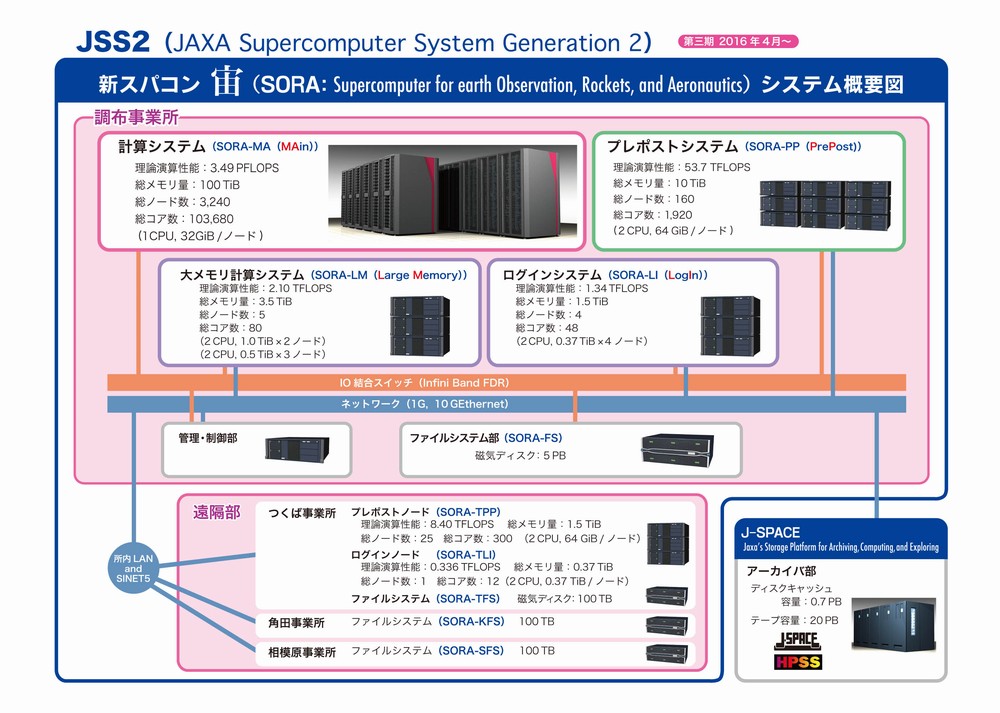 JAXA supercomputer JSS2 |
 work stations |
風洞設備 Wind Tunnels
大山研究室所有の小型低速2次元風洞,小型超音速風洞を主に使っています.
小型低速2次元風洞は吸い込み式風洞で,計測部が(W)100mm (H)600mmあり,30m/sまでの風速を出すことができます.
圧力孔計測やPIV計測などをすることができます.現在は主にプラズマアクチュエータによる翼周りの流れ場制御の実験に使われています.
小型超音速風洞は真空タンクに大気を吸い込む方式で,シュリーレン計測などをすることができます.
現在は主に超音速ジェットの実験に使われています.We primarily use the small two-dimensional low-speed wind tunnel and small supersonic wind tunnel owned by the laboratory. The low-speed tunnel is a suction-type wind tunnel with a test section measuring 100 mm in width and 600 mm in height, and it can achieve wind speeds of up to 30 m/s. It supports pressure-tap measurements and particle image velocimetry (PIV), among other techniques. It is currently used mainly for experiments on controlling the flow around airfoils using plasma actuators. The small supersonic wind tunnel draws atmospheric air into a vacuum tank and supports schlieren measurements, among other techniques. It is currently used mainly for experiments on supersonic jets.
 Two-dimensional low-speed wind tunnel |
 Supersonic wind tunnel |
For one to two weeks each year, we use the large transonic and supersonic wind tunnels, which are shared facilities at the JAXA Institute of Space and Astronautical Science. These are blowdown wind tunnels with test sections measuring 600 mm in width and 600 mm in height. The transonic tunnel operates over a Mach number range of 0.3–1.3, and the supersonic tunnel over a range of 1.5–4.0. Test runs last at least 30 seconds. We also have access to a planetary-environment wind tunnel that allows experiments under conditions simulating the Martian atmosphere. This closed-circuit tunnel allows the freestream pressure to be varied from 0.01 to 1 atm and can achieve a maximum wind speed of approximately 100 m/s. Its circular test section is 1.6 m in diameter. It is one of the few wind tunnels in the world capable of testing under reduced-pressure conditions.
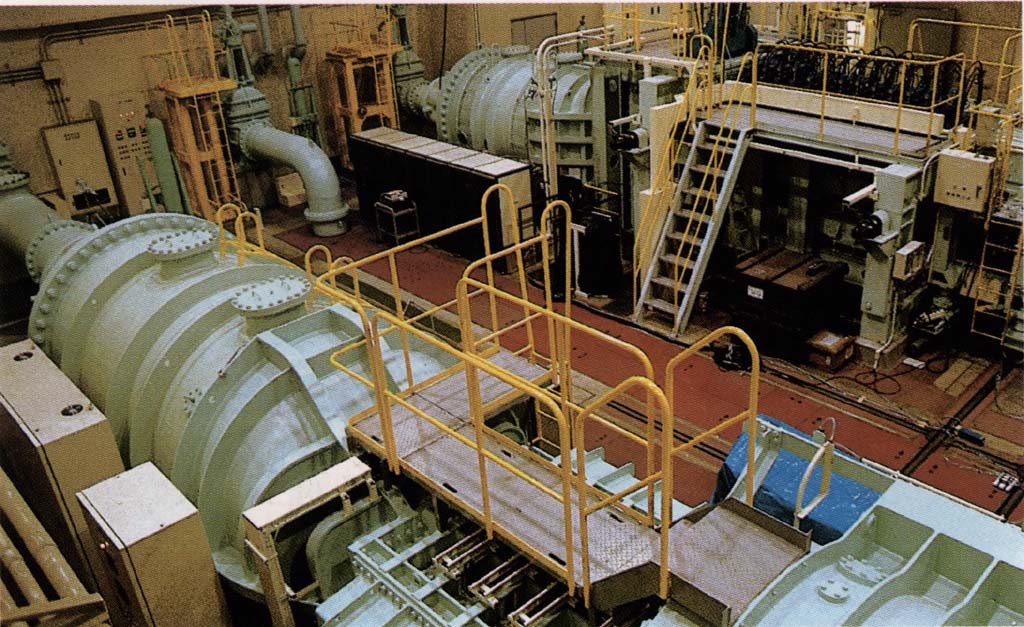 Transonic/supersonic wind tunnel |
Planetary-environment wind tunnel |
